
Jaylen Brown trade: How did his relationship with the Celtics crumble?
Three months ago, Jaylen Brown was finishing off his best season as a pro, averaging 28.7 points per game and taking a leap from All-Star to All-NBA player in Jayson Tatum’s absence while leading the Boston Celtics to the East’s No. 2 seed in what most projected to be a gap year.
Now, Brown is reportedly a member of the rival Philadelphia 76ers after a shocking trade on Wednesday that sent Brown to Philly in exchange for Paul Georgetwo first-round picks and two second-round picks. After a decade in Boston that included 10 trips to the playoffs, five All-Star appearances and a championship, it was stunning to see the Celtics so frantic in trying to unload Brown. That they ultimately took back a package with just two first-round picks — after reports indicated they were asking for four as recently as a week ago — and George coming off his two worst seasons in more than a decade is almost unbelievable.
Where most trades involving star talent include some level of player involvement at this point, ESPN’s Brian Windhorst reported earlier in the week that he’d heard team president Brad Stevens and the Celtics were offering Brown “everywhere.” That was corroborated by ESPN’s Shams Charania‘s note after the trade that Boston had been “full-blown shopping” Brown around the league over the past week. That doesn’t happen if there’s a salvageable relationship between player and franchise.
Jaylen Brown trade grades: 76ers get ‘A+’ for landing Celtics star as Boston makes baffling decision
Sam Quinn
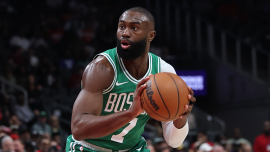
Everything about this felt out of character for the way the Celtics have operated for the last decade. Every move Stevens made felt surgical, but Brown’s trade was the opposite. After years of rarely making so much as a minor misstep, to have the team’s relationship with Brown completely implode to the point of a hurried trade just to get him out is almost disorienting.
How the relationship between the Celtics and Brown got to this point is a question that will be steadily unpacked all summer. Plenty of behind-the-scenes revelations will surface in the coming weeks and months, offering further insight. But with this trade, it’s abundantly clear that things had reached a breaking point with a rift that could not be bridged.
So, how did we get here? That’s a complicated question that goes back almost to the beginning, but escalated rapidly over the past few months.
The relationship between Jaylen Brown, Jayson Tatum
A year after Brown was drafted third overall by the Celtics in the 2016 NBA Draftthey added another young star wing by selecting Tatum at No. 3 in 2017. “The Jays” enjoyed immediate success, but as their stars grew, so did the chatter questioning whether they would co-exist given their respective desires to be the top star.
Both Brown and Tatum publicly dismissed any internal animosity over the years, but as Tatum emerged as the Celtics’ leading man in recent years, many wondered how much it irked Brown to be viewed as the Robin to Tatum’s Batman. As the Celtics fell short of a championship in the first six years of their partnership, there were constant questions about whether they were the right pairing or if their overlapping skill sets would be better served on separate teams.


A championship in 2024 quieted that noise, with Brown earning some personal accolades with a Finals MVP trophy. Brown was also handsomely compensated by the Celtics, earning a five-year, $285 million contract. But elite athletes aren’t often satisfied with just having the contract or even the chance to win championships. Legacy matters and even Brown’s Finals MVP didn’t change the public perception about who was the top dog in Boston. It wouldn’t be hard for Brown to feel like he was not getting the level of respect he deserved, and the strain on that relationship and the challenge in managing those two egos only got tougher this season when Brown thrived in a leading role with Tatum sidelined by the Achilles injury he suffered in the 2025 playoffs.
Brown averaged 28.7 points, 6.9 rebounds and 5.1 assists per game on 47.7/34.7/79.5 shooting splits to become an MVP candidate while Tatum missed the majority of the year rehabbing his Achilles tear. Brown proclaimed himself the league’s best two-way player on multiple occasions, clearly feeling his season in a leading role affirmed he could thrive as the top dog.
When Tatum returned, it was in a secondary role as he was still limited while ramping up after an extended absence. Vibes were high as the postseason arrived, but a stunning seven-game loss to the Sixers in the first round derailed everything.
The summer Twitch streams
Brown has never been afraid to speak his mind, but his turn as a Twitch streamer undoubtedly caused some headaches in the Celtics’ building as he grew more unfiltered on his own platform. Brown earned himself a $50,000 fine for calling into question the officiating in Boston’s playoff loss to the Sixers. He also called out Joel Embiid for flopping — a fun subplot to monitor as Brown makes his way to Philly.
Jaylen Brown calls out Joel Embiid for flopping, says NBA refs have ‘agenda’ against him during Twitch stream
Sam Quinn

He also made some telling comments. Brown notably called this past season — when he led the show with Tatum out injured — his “favorite” in his career, quite the statement given he won a championship two years ago. While he insisted that it was because he loved seeing Boston’s young guys thrive, it wasn’t hard to read that as Brown enjoying the chance to finally be the lead option.
Brown continued his streams through the summer, and things took another turn once the Giannis Antetokounmpo sweepstakes began heating up.
The Giannis trade talks
Brown’s name has appeared in trade rumors before, but Boston’s pursuit of Antetokounmpo ahead of June’s NBA Draft was different. Previously, Brown’s name had popped up here and there over the years, with Boston rebuffing offers. But this time, it was the Celtics who were actively trying to trade Brown.
While understandable to most on the outside for Boston to put up their best possible offer to try to land Antetokounmpo, for a player who has made it clear he believes he’s the best two-way player in the world, Brown may have taken that as a slap in the face.
“Somewhat grateful, because I get to see some negativity that I didn’t want. But that just gives more fuel to the fire,” Brown said on a stream. “I see some comments, or takes, that I didn’t even care to see, but it just gives me more fuel to the fire. To all the people who have doubted me, that want me to do this or want me gone, you’re turning me into a monster.”
What we don’t know is what the conversations between Stevens and Brown were like before and after those trade talks. If this trade is any indication, it seems like a pretty educated guess that they went poorly. The Celtics quickly pivoted from an understandable pursuit of Antetokounmpo to shopping Brown to any team that would listen. That’s not something you often do with a player who just finished sixth in MVP voting. Somewhere along the way, though, the two sides must have reached a point where they knew it was time to part ways.
Boston was a beacon of great organizational operation for a decade, but the mismanagement of the relationship with Brown felt sloppier than anything we’ve seen in Stevens’ tenure in charge — both as coach and as president. A team that once seemed destined for a long runway of contention faces serious questions.
The Celtics will enter the 2026-27 season with a lot of uncertainty. And with the New York Knicks fresh off a title, Antetokounmpo joining the Miami Heat, Kawhi Leonard back with the Toronto Raptors and now Brown in Philadelphia, Boston’s place in that hierarchy is unclear.
We’ll wait to learn the exact details of what fractured the relationship between star and team, but Brown’s departure is a wound that won’t heal quickly.
TNG – Latest News & Reviews


