
LaMelo Ball trade winners and losers: Wolves land elite backcourt mate for Anthony Edwards
The NBA never fails to provide entertainment. Just days after the Miami Heat won the Giannis Antetokounmpo sweepstakes, ending a years-long saga over the two-time MVP’s future, the Charlotte Hornets have stunned the basketball world by trading star guard LaMelo Ball to the Minnesota Timberwolves.
Here’s a look at the full deal, according to multiple reports:
- Timberwolves receive: LaMelo Ball, Josh Green
- Hornets receive: Naz Reid, 2033 first-round pick, three first-round pick swaps (2028, 2029, 2030), three second-round picks (2029, 2032, 2033)
As the dust settles from this blockbuster deal, let’s take a look at some of the immediate winners and losers:
Winner: Anthony Edwards


Here are the point guards that Edwards has played with over his first six seasons in Minnesota:
That is not an inspiring list, especially considering Edwards only played with Rubio during his rookie season, and by the time Conley got to Minnesota, he was in his late 30s. Ball, who was selected third, two picks after Edwards, in the 2020 NBA Draftfinished ninth in the league in assists last season with 7.1 per game. He will immediately be the best backcourt mate Edwards has had.
While Edwards’ own playmaking has improved over the course of his career, he is, first and foremost, a scorer. He averaged a career-high 28.8 points per game last season. Playing alongside Ball will make it significantly easier for him to do that.
The 6-foot-7 Ball is a uniquely gifted playmaker who loves to push the pace and puts tremendous pressure on the defense. Moreover, he’s a gifted scorer himself, which will make it more difficult for opposing defenses to gear their entire game plan toward Edwards.
LaMelo Ball trade grades: Timberwolves get ‘B+’ for high-risk, high-reward move, Hornets take the long view
Sam Quinn
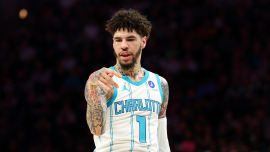
Loser: Kon Knueppel


Knueppel, the No. 4 pick in the 2025 NBA Draft by the Hornets, finished as the runner-up to Cooper Flagg in an electric Rookie of the Year race last season after averaging 18.5 points, 5.3 rebounds and 3.4 assists on 47.5/42.5/86.3 shooting splits.
Knueppel immediately established himself as one of the best off-ball players in the league, and while he’s not suddenly going to fall off a cliff without Ball, there’s no question that he’ll miss his point guard. Cutting and movement shooting are dependent traits that require a high-level playmaker, and few players have Ball’s combination of size and vision.
Last season, 76.7% of Knueppel’s field goals were assisted. Among his fellow top-40 scorers — Knueppel was 37th in the league in scoring — only Trey Murphy (76.9%) had a higher percentage of assisted field goals. Unsurprisingly, no one assisted Knueppel more than Ball, who threw Knueppel 670 total passes, resulting in 110 assists.
It’s worth noting the stark discrepancy in Knueppel’s 3-point numbers off passes from Ball compared to all other shots.
|
Catch-and-shoot from Ball |
76 |
158 |
48.1% |
|
Catch-and-shoot from someone else |
133 |
335 |
39.7% |
|
Off-the-dribble |
64 |
149 |
43% |
Is some of that noise? Probably, but you can’t discount the impact Ball had — not only as a playmaker, but as a scorer who demanded defensive attention that opened up opportunities for Knueppel.
Winner: Coby White

The Hornets acquired White from the Chicago Bulls at last season’s trade deadline with the hope that he would help them make the playoffs. While they ultimately fell short of that goal, White proved to be a valuable addition. He averaged 15.6 points and three assists in 21 games with the Hornets, and shot 39.1% from 3-point range.
Notably, in their dramatic 127-126 win over the Miami Heat in the first round of the Play-In Tournament, White scored 19 points off the bench and hit five 3s, including an incredible fadeaway to force overtime.
White, a North Carolina native who played his college basketball at the University of North Carolina, was always likely to re-sign with the Hornets in free agency this summer, but Ball’s departure made the decision easier and gave him some real leverage in negotiations.
In fact, White has already agreed to a three-year, $74 million deal, per ESPN. After making $47 million in his first six seasons in the league combined, White will now make nearly $25 million per year. On the court, White will step into the starting point guard role and have a chance to run the offense alongside Knueppel and Brandon Miller.

Loser: Hornets fans
Few long-time NBA cities have seen less success than Charlotte.
The original Hornets franchise, which existed from 1988 to 2002, won four playoff series and never made it past the second round before relocating to New Orleans. After a brief hiatus, NBA basketball returned in 2004 with the expansion Charlotte Bobcats, who later reclaimed the original Hornets name and franchise history in 2014. The new iteration of the franchise has only been to the playoffs three times and hasn’t won a single series.
For much of their history, the Hornets have been a laughingstock, an example of what not to do. In nearly four decades, they have only had two windows with any real hope: the late 1990s to early 2000s — they were one game away from the Eastern Conference Finals in 2001 — and a few brief years in the mid 2010s. Their current playoff drought, which stretches back to 2016, is not only the longest in the league, but double that of any other team.
Longest NBA playoff droughts
While they fell one game short of the playoffs last season, losing to the Orlando Magic in the Play-In Tournament, the city once again had a team to be proud of, and the Hornets were on the rise with one of the league’s most exciting young cores.
Now, suddenly, their best and most popular player has been traded.
There are valid reasons for the move, namely Ball’s history of poor health. And they got back a very good player in Naz Reid with some potentially valuable draft capital. The Hornets still have a bunch of talented young players, and it’s certainly possible they come out ahead in the long run. But right now, this deal is a gut punch for the fans.
Winner: Tim Connelly’s maverick reputation
Timberwolves president of basketball operations Tim Connelly has long been one of the NBA’s most aggressive executives and has built successful teams in Denver and Minnesota largely by not being afraid to make daring moves.
In 2021, while running Denver, Connelly traded long-time fan and organization favorite Gary Harris, RJ Hampton and a 2026 first-round pick to the Magic for Aaron Gordon, a move that ultimately led to the Nuggets’ first championship in franchise history.
A year later, shortly after taking over in Minnesota, he gave up a massive haul that included Malik Beasley, Walker Kessler and four first-round picks to acquire Rudy Gobert in a deal that was widely criticized at the time. Though the Wolves have never won a title, they’ve been extremely successful with Gobert and made back-to-back Western Conference Finals in 2024 and 2025.
Ahead of the 2024-25 season, Connelly sent Karl-Anthony Towns, another extremely popular player, to the New York Knicks in exchange for Julius Randle, Donte DiVincenzo and a future first-round pick. That move hasn’t panned out; Towns just won a title with the Knicks, they had to salary dump Randle and DiVincenzo tore his Achilles tendon in the playoffs last season.
If there were any questions about whether the outcome of the Towns-Randle deal would change Connelly’s approach, they have been answered emphatically with the Ball acquisition. This is arguably the riskiest move Connelly has made, and it will be fascinating to see how it pans out.
Loser: Rudy Gobert

When the 7-foot-1 Gobert arrived in Minnesota in 2022, he became the anchor for an elite defense, helping make the Timberwolves one of the biggest, most physical teams in the league. Gobert has played alongside Towns, Randle, Reid and Jaden McDaniels in the Wolves frontcourt, and in his four seasons with the team, they have never finished worse than 10th in defensive rating.
Timberwolves’ defensive rating with Gobert
|
2022-23 |
113.1 |
10th |
|
2023-24 |
108.4 |
1st |
|
2024-25 |
110.8 |
6th |
|
2025-26 |
112.5 |
8th |
Now, McDaniels is the only one who remains, and he’s really more of a wing. Aside from Gobert and McDaniels, the only player under contract for next season who is taller than 6-foot-8 is 19-year-old Joan Beringer (6-foot-11). The No. 17 overall pick in last year’s draft, Beringer played just 314 minutes last season.
While most teams have been intent on adding size in recent years, the Wolves are now significantly smaller than they were last season, and Ball, for all of his offensive brilliance, is largely uninterested in playing defense. The combination of those factors will place a greater burden than ever on Gobert as he enters his age-34 season.
Gobert has been extremely durable throughout his career, and over his four seasons in Minnesota, he has only missed 34 regular-season games. The Timberwolves are counting on that trend to continue. If Gobert misses any sort of significant time, they could be in big trouble.
TNG – Latest News & Reviews


