
Un Nuovo Crash di Bitcoin è Possibile? Perché la Salute della Rete Conta Davvero e Come Potrebbe Intervenire Bitcoin Hyper
Market volatility has once again kicked in, with many traders wondering whether Bitcoin ($BTC) could face another significant decline. Usually the focus is almost exclusively on the price, but often it is some internal weaknesses of the network that generate further fears. Limitations such as slow confirmations and high fees can add to the pressure at critical times.
Over the past 24 hours, Bitcoin has fallen below $90,000 and prompted liquidations of over $568 million, with the majority coming from long positions. Added to this was the appearance of the so-called death cross – a moving average crossing where the short-term average falls below the long-term average. In technical analysis, this crossing is often interpreted as a potential signal of weakness, even if it does not necessarily guarantee further declines.
When the market accelerates, the Bitcoin network struggles to handle the increase in activity. Transaction confirmations, which under normal conditions take several minutes, can take hours. Fees – often called “gas” although the term is more common on other blockchains – can add up quickly. This creates congestion and makes it difficult to move funds to exchanges to sell or to an offline wallet for added security.
These delays aren’t just a technical problem: they can make things worse in times of uncertainty. If users fail to move their BTC when they need it, their ability to react to market movements is drastically reduced.
The underlying problem is scalability, i.e. the system’s ability to handle a high number of transactions simultaneously. This limitation has long held back the possibility of transforming Bitcoin into a solid foundation for decentralized applications (dApps) and advanced services.
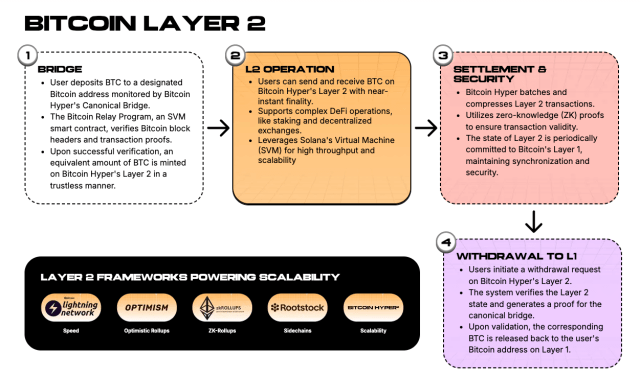
In recent years, however, the focus has shifted to Layer-2 solutions: protocols built on top of the main blockchain that seek to combine the security of Bitcoin with greater speed and flexibility. The objective is to address precisely the problems that emerge in moments of strong market stress.
Among the projects that aim to improve the overall functioning of the ecosystem is Bitcoin Hyper ($HYPER)which proposes an infrastructure capable of increasing the capacity of the network and introducing advanced features.
EXPLORE: Best Online Casinos

Building a dApp and DeFi Ecosystem on Bitcoin
The implications of this architecture go beyond just speed. By introducing smart contracts, Bitcoin Hyper could open the door to the creation of a true application ecosystem on Bitcoin. This includes decentralized finance (DeFi) projects for lending, staking and automated trading, dynamic NFT platforms and gaming applications based entirely on blockchain.
Developers might use familiar languages like Rust – already widespread in web3 development – to build and distribute applications.
An important element will be the Canonical Bridgedesigned to allow simple and secure transfers of $BTC between the primary and secondary tiers, while maintaining liquidity and accessibility.
The native token $HYPER will serve as the core element of the ecosystem, with roles related to governance and staking rewards. With the possibility of staking tokens since token generation event (TGE), the project aims to involve its community right away.
Currently, the token is available for pre-sale at $0.013295with the possibility of staking it for an annual return of 41%.
Vai a Bitcoin Hyper
TNG – Latest News & Reviews


