
Why NBA is looking into Gary Trent Jr.’s curious $64M extension from Bucks
Gary Trent Jr. is coming off the worst season of his career. His last two free agent contracts came for the minimum salary in 2024 and a 20% raise on that minimum salary through Non-Bird Rights in 2024. The 2023 Collective Bargaining Agreement has made NBA finances tighter than ever, with teams far less willing to hand out pricey, long-term deals than before.
All told, the expectation on merit would have been for Trent to get only a minimum or near-minimum deal. Instead, he signed a fully guaranteed four-year, $64 million contract to return to the Milwaukee Bucks.
Almost immediately, a chorus of salary cap circumvention allegations rained down on the Bucks from fans and media figures. Now, sure enough, the NBA told multiple outlets on Thursday that it will “look into” the contract. So, why are so many people so convinced that the Bucks circumvented the cap in order to sign Trent?


What’s so curious about Gary Trent Jr.’s new contract?
The theory here relates to the mechanism by which teams may go over the cap to retain their own players: Bird Rights. When a team signs an external free agent, it must use either cap space or a cap exception in order to pay them. One year after signing with that team, it can use Non-Bird Rights to give that player a 20% raise. After two years, teams gain access to Early Bird Rights, which allows them to pay those players a 75% raise or 105% of the league’s average salary in the previous season, whichever is higher. And after three years, teams gain full Bird Rights, which give them the right to pay that player anything up to the max.
When Trent became a free agent in 2024, he was coming off a three-year, $51 million contract and was initially expected to get paid in that range again. When his market dried up, his best offers were reportedly at the taxpayer mid-level exception of around $5.2 million.
Explaining four most confusing moves of NBA offseason: Gary Trent for $64M? Two years for DeAndre Jordan?
Sam Quinn
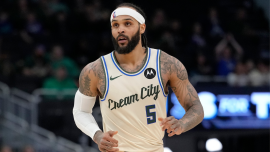
At the time, the capped-out Bucks could only offer him the minimum because they were deep into the luxury tax. Yet he signed in Milwaukee seemingly to reunite with former teammate Damian Lillard and join a team potentially set up to win. In 2025, he remained in Milwaukee using Non-Bird Rights. Now, finally, in 2026, he re-signed for $64 million, just $4 million below the maximum amount allowable under the Early Bird Rights system.
In immediate basketball terms, this makes no sense. Trent is coming off a season in which he averaged 8.1 points in 21.2 minutes per game. He fell out of Milwaukee’s rotation at one point. He is a complete non-factor as a defender, rebounder and passer, and the Bucks have far more guards than they have minutes to play them with.
Yet Trent just received the eighth-biggest total contract of free agency thus far. In an era in which teams are extremely cautious about guaranteed money and long-term deals, Trent got the maximum four years fully guaranteed.
The theory, therefore, is that either in 2024, when Trent initially signed, or 2025, when he re-signed, the Bucks agreed in advance to overpay Trent in the future to secure his commitment. If true, this would be an obvious case of circumvention in line with the violation the Minnesota Timberwolves once committed with Joe Smith. In 1999, Smith signed a contract with the Timberwolves that was well below his perceived market value, but did so with an agreement in place to re-sign for far more money once he had accrued the Bird Rights needed to do so.
That violation drew a penalty that cost the Timberwolves five first-round picks (though two were eventually given back) in part because there was a paper trail. It’s hard to imagine any player and team would be careless enough to put this in writing nowadays, but the basic structure lines up here with the major difference being that Smith planned to wait until he had accrued full Bird Rights, not just Early Bird Rights.
Still, rumors abounded surrounding Trent for some time leading up to his free agency.
“Everybody in the league has been whispering for two months, minimum, about, like, ‘hey, I think there’s kind of like a crazy contract coming down the pike for Gary Trent Jr. after those two one-year contracts established his Early Bird Rights with the Bucks,’ and boom, it happened yesterday,” The Ringer’s Zach Lowe said on an episode of his podcast released Wednesday.
Bucks have violated free agency rules in the past
Though the Bucks have never been punished for cap circumvention, they have been punished for violating free agency rules before. In 2020, reports indicated that they had agreed to a sign-and-trade deal to acquire Bogdan Bogdanović from the Sacramento Kings before free agency had even begun. That is not allowed, and the Bucks were stripped of a second-round pick.
They have also used the Bird Rights system to secure free agents who were seemingly out of their price range at the time and then eventually pay them more appropriate contracts. In 2020, they landed Bobby Portis for the bi-annual exception. He got a small Non-Bird raise in 2021, after helping them win a championship, and then in 2022, they re-signed him to a four-year, $48 million deal using Early Bird Rights.
The NBA is currently almost 11 months into a separate cap-circumvention investigation involving Kawhi Leonard and the Los Angeles Clippers, which demonstrates just how difficult it is to prove circumvention occurred. However, Article 13 of the NBA’s Collective Bargaining Agreement states that circumvention “may be proven by direct or circumstantial evidence, including, but not limited to, evidence that a Player Contract or any term or provision thereof cannot rationally be explained in the absence of conduct violative of Section 2(a) or 2(b).”
Essentially, if the only possible explanation for a contract is cap circumvention, then the league can rule that the cap was circumvented. The Bucks and Trent could argue that he simply had a down year, is only 27 and could easily bounce back in the future. But based on his performance last season and the free-agent market we just witnessed, it should hardly be viewed as a surprise that this contract caught this much attention.
Trent’s extension looks nonsensical on paper, and now, the NBA will attempt to get to the bottom of why the Bucks would offer it to him.
TNG – Latest News & Reviews


